
Softwares
The softwares developed by our laboratory members are released here.
Molecule Design Tool: YU canvas
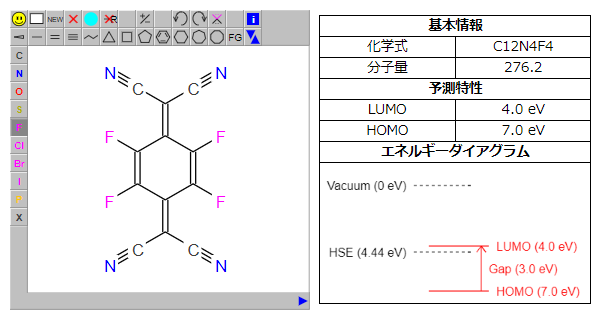
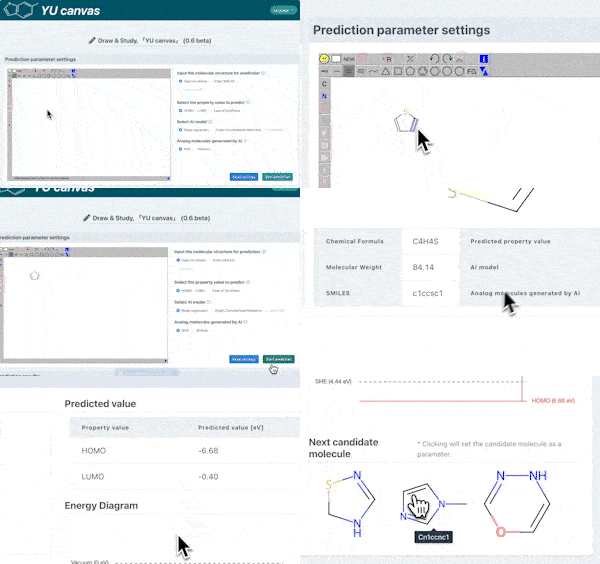
YU canvas is a software for designing functional molecules, developed by our group. You can draw molecules in the left-side canvas, and see the predicted properties immediately in the right-side table.
Program for the calculation of mobility tensor: mcal

Mobility, which represents the ease of electron flow, is used as an indicator to evaluate the performance of organic semiconductors. We developed a program for the calculation of mobility tensor “mcal” that can calculate mobility taking into account the continuity of hopping pathways based on crystal structures. mcal is developed in Python and can be easily installed via PyPI. It is available free of charge under the MIT License for anyone with a CIF file. It requires Gaussian 16 or 09 for internal DFT calculation.
Program for the calculation of transfer integral: tcal
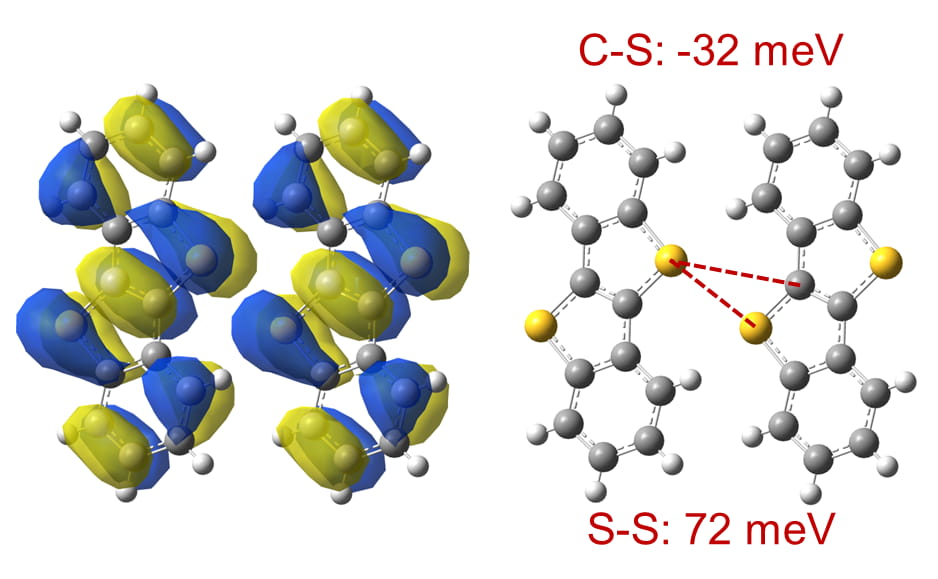
Organic semiconductors have attracted attention for thier application in wearable devices and flexible displays due to their advantages such as low cost, thinness, flexbility, and light weight. Mobility and transfer integrals are important performance parameters which represent the ease of charge carrier transport. We have developed “tcal”, a program for transfer integral calculation based on the density functional theory (DFT). It enables us to calculate not only standard intermolecular transfer integrals but also interatomic transfer integrals, which represent the contribution of each atom to the intermolecular transfer integrals. tcal is coded in Python and is available free of charge under the MIT license. It requires Gaussian 16 or 09 for internal DFT calculation.
Droplet Simulator: HyDro
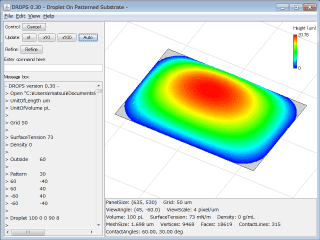
HyDro is a simulation software for the wetting phenomena of liquid droplets on solid surface, developed by Hiroyuki Matsui when he was at National Institute of Advanced Industrial Science and Technology (AIST), Japan. It simulates the shape of droplet placed on hydrophilic/hydrophobic patterns effectively and accurately by our original algorithm, Hybrid Energy Minimization (HEM) method.